

What is Binomo, and how does it work?
Binomo is an online trading platform launched around 2014, owned by Dolphin Corp LLC, a company registered in St. Vincent and the Grenadines. The platform markets itself as a place where anyone can trade financial instruments and earn money from home with minimal capital. Its minimum deposit is $10, and trades can start at just $1, which explains why it attracts beginners looking for a low-barrier entry into online trading.
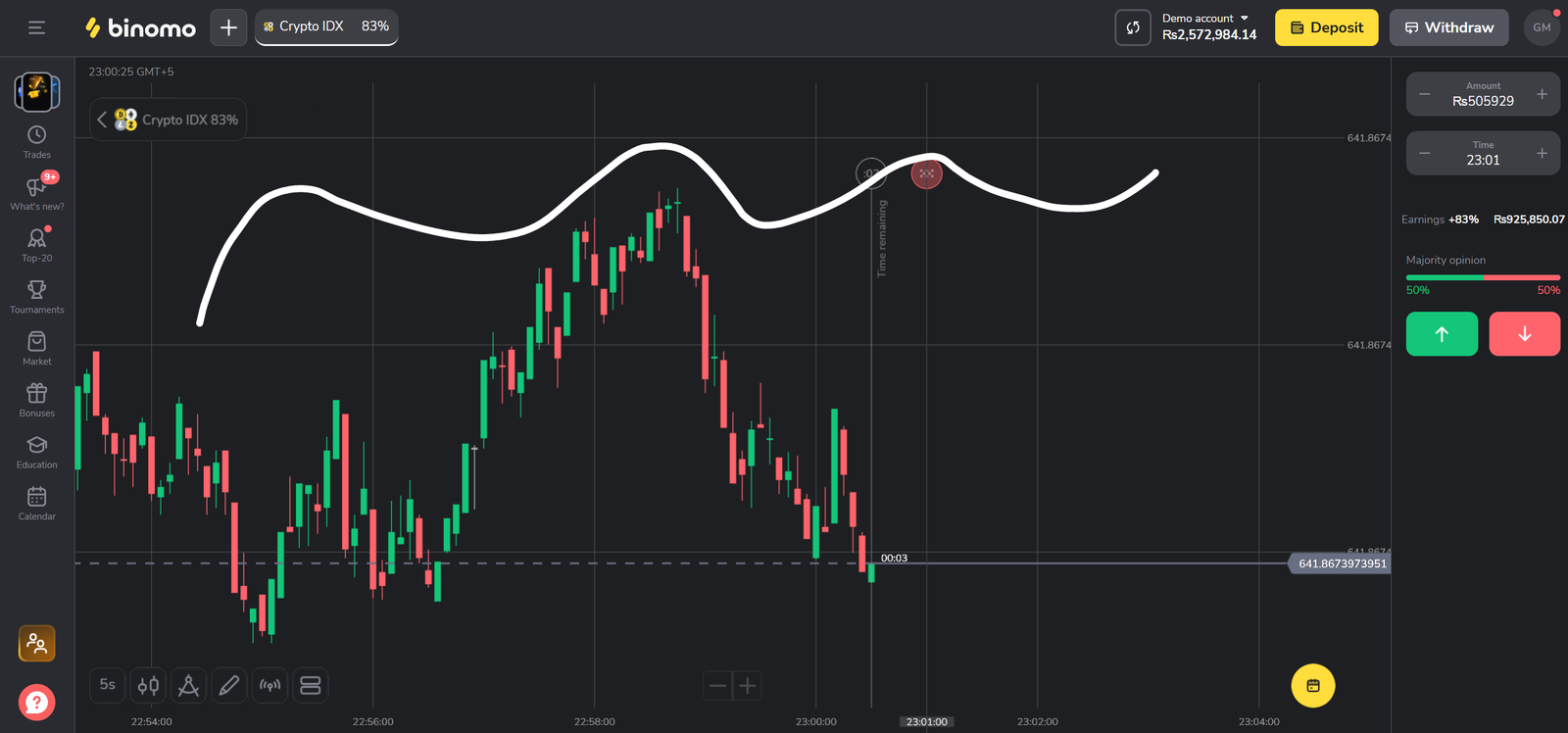
The core mechanism on Binomo is fixed-time trades (FTT), often called binary options. Here is how it works: you pick an asset (a currency pair, stock index, commodity, or a crypto-based index), predict whether its price will move up or down within a set time window (60 seconds to 1 hour), and place your trade. If your prediction is correct, you receive a fixed payout, typically between 70% and 87% of your stake. If you are wrong, you lose the entire trade amount.
Binomo does offer two crypto-related instruments called Crypto IDX and Altcoin IDX, which are synthetic indices derived from the average price movements of Bitcoin, Ethereum, Litecoin, and other altcoins. But these are not actual cryptocurrencies. You cannot buy, hold, or transfer real Bitcoin or Ethereum on Binomo. You are placing directional bets on price movements of a computed index, which is a fundamentally different activity from cryptocurrency trading on an exchange like Coinbase or Binance.
Is Binomo actually a crypto trading platform?
This distinction matters. On regulated cryptocurrency exchanges, you purchase and own digital assets. You can store Bitcoin in a wallet, transfer it, or use it. On Binomo, you never own anything. You are speculating on short-term price direction through contracts that expire within minutes. The U.S. Commodity Futures Trading Commission (CFTC) classifies this type of instrument as a binary option, not as cryptocurrency trading.
Crypto IDX on Binomo tracks a weighted average of four major coins. The payout for a correct prediction is around 83% for standard accounts. Altcoin IDX tracks a basket of smaller cryptocurrencies with a lower payout of approximately 40% for standard users. These are proprietary instruments created by the platform itself, and their pricing methodology is not independently auditable in the way that exchange-traded assets are.
Regulation: where does Binomo stand?
Regulatory status is the first thing any serious trader should investigate before depositing money on a platform. Binomo is registered in St. Vincent and the Grenadines, an offshore jurisdiction known for minimal financial oversight. The company holds no license from any top-tier financial regulator such as the U.S. Securities and Exchange Commission (SEC), the U.K. Financial Conduct Authority (FCA), or the Australian Securities and Investments Commission (ASIC).
Binomo’s only claimed regulatory affiliation is with the International Financial Commission (IFC), a private dispute resolution organization based in Hong Kong. The IFC is not a government regulator. It cannot enforce laws, conduct audits, or protect investor funds through deposit insurance. It functions as a mediation service, and its decisions are not legally binding in the same way that rulings from FCA or SEC would be.
Regulator | Status | Source |
|---|---|---|
FCA (UK) | Warning issued against Binomo Fx Trading | fca.org.uk |
CySEC (EU) | Flagged as unauthorized entity | financemagnates.com |
SEC / CFTC (USA) | Not registered | cftc.gov |
RBI (India) | Listed on Alert List of unauthorized platforms | financialexpress.com |
ASIC (Australia) | Not registered | brokerchooser.com |
Multiple government agencies have issued warnings about Binomo. The UK FCA has listed a variation called “Binomo Fx Trading” as an unauthorized firm. CySEC flagged Binomo as operating without authorization in the European Union. The Reserve Bank of India placed Binomo on its official alert list of unauthorized forex trading platforms. These are not advisory notes. They are formal public warnings from financial regulators telling citizens that these platforms operate outside the law.
The math behind binary options: why most traders lose
Understanding the mathematical structure of binary options explains why the vast majority of participants lose money over time. When a platform offers an 83% payout on winning trades but you lose 100% on losing trades, the math is straightforward. You need to win more than 54.05% of your trades just to break even. At an 85% payout, the breakeven point is 54.64%. At a 40% payout (Altcoin IDX), you need a win rate above 71.43%.
Those breakeven thresholds are deceptively hard to sustain. Research published by Broksal found that 70% to 80% of retail binary options traders lose money across regulated markets. In an enforcement action by the U.S. SEC against EZTD, regulators revealed that fewer than 3% of roughly 4,000 U.S. investors who opened binary options accounts made any profit at all. Forbes described the expected value this way: an investor “could expect, on average, to lose money” because the house edge is built into the payout structure.
Payout Rate | Breakeven Win Rate | Estimated Loss Rate |
|---|---|---|
85% | 54.05% | 70-80% of traders lose |
83% | 54.64% | 70-80% of traders lose |
40% | 71.43% | 90%+ lose at this level |
Think of it this way: even if you flip a fair coin, you would expect to win 50% of the time. But 50% wins at an 83% payout still results in a net loss. You would win 83 units on your winning trades and lose 100 units on your losing trades, ending up 17 units in the red for every 200 units wagered. The system is designed so the platform profits from aggregate trader losses.
Red flags to watch for
Financial regulators and consumer protection agencies worldwide have identified common warning signs of problematic trading platforms. The CFTC published a guide titled “10 Signs of a Scam Crypto or Forex Trading Website.” FINRA, the SEC, and the FTC have issued similar guidance. When you evaluate Binomo against these established red-flag lists, several concerns emerge.
First, the platform is registered in an offshore jurisdiction with no real regulatory oversight. Second, Binomo’s bonus structure locks deposited funds behind volume requirements before withdrawal is allowed. Third, user complaints on platforms like Trustpilot, Voxya, and Sikayetvar document withdrawal delays spanning weeks or months, with some users reporting that withdrawal requests marked “successfully processed” never actually credited to their bank accounts. Fourth, the aggressive marketing through YouTube influencers and social media ads targets inexperienced traders with promises of easy income. Fifth, the platform provides its own pricing feed for its synthetic instruments, meaning there is no independent verification of the prices you are trading against.
Where are binary options actually banned?
Binary options for retail traders have been banned or severely restricted in many major markets. The European Securities and Markets Authority (ESMA) prohibited binary options for retail traders across the EU in 2018. The UK FCA enforced its own ban in 2019. Israel banned binary options entirely in 2017, becoming the first country to do so. Australia’s ASIC banned them for retail clients. In the United States, binary options can legally trade only on CFTC-registered exchanges, which effectively makes most online binary options platforms illegal for American users.
Region | Status |
|---|---|
United States | Only on CFTC-registered exchanges |
European Union | Banned for retail since 2018 |
United Kingdom | Banned for retail since 2019 |
Israel | Complete ban since 2017 |
Australia | Banned for retail clients |
India | Binomo on RBI Alert List |
Canada | Provincial warnings issued |
These bans were not arbitrary. Regulators examined the data, found that retail traders consistently lost the majority of their funds, and concluded that the product structure itself was fundamentally harmful to consumers. When governments across multiple continents independently reach the same conclusion, that is a strong signal worth paying attention to.
Safer alternatives for actual crypto trading
If your goal is to make money online through cryptocurrency, regulated exchanges offer a completely different and more transparent trading environment. On these platforms, you buy and own real digital assets. You decide when to sell. Your holdings are stored in wallets you control or in accounts backed by regulatory protections.
Platform | Best For | Regulation |
|---|---|---|
Coinbase | Beginners, ease of use | SEC-regulated public company |
Kraken | Security, low fees | Licensed in US, UK, EU, Japan |
Binance | Advanced features, low fees | Licensed in multiple jurisdictions |
Crypto.com | Rewards, DeFi features | Licensed in multiple jurisdictions |
Gemini | Compliance, security | NYDFS-regulated trust company |
Interactive Brokers | Professional-grade trading | SEC, FCA regulated |
These platforms are recommended by major financial publications including Forbes, NerdWallet, Investopedia, and Money.com in their 2025 and 2026 best-exchange rankings. They are publicly listed or regulated by government authorities with strict compliance requirements. Coinbase, for example, is a publicly traded company on NASDAQ subject to SEC reporting requirements. Kraken and Gemini hold licenses from state and federal regulators in the United States. This is the regulatory framework that protects your money when something goes wrong.
Practical advice for anyone considering Binomo
If you have already opened a Binomo account or are thinking about it, consider these steps before depositing significant funds. Use the $10,000 demo account first. Treat it as a test of the platform’s reliability and your own trading strategy. Track your win rate over at least 100 trades. If you cannot sustain a 55%+ win rate consistently in demo mode, the math tells you real-money trading will result in losses.
Read the bonus terms carefully before accepting any promotional offers. Many Binomo bonuses require you to trade a specific multiple of the bonus amount before you can withdraw any funds at all. This is a common mechanism that effectively locks your deposit in place. Check complaint databases such as Trustpilot, Voxya, and the Reddit community at r/binaryoptions to see what current users report about withdrawal processing times.
Verify whether binary options trading is legal in your country of residence. Using platforms on your country’s regulatory alert list can result in legal consequences, frozen bank accounts, or loss of funds with no legal recourse. The RBI alert list in India and the FCA warning in the UK are not suggestions. They are formal notices with legal weight.
Final assessment
Binomo is a real platform where you can trade synthetic financial instruments with small amounts of money. It is not a cryptocurrency exchange, and treating it as one leads to a fundamental misunderstanding of what you are actually doing. The platform operates from an offshore jurisdiction with no top-tier financial regulation, has been warned against by multiple government agencies, and uses a payout structure where the mathematical expected value is negative for the trader.
The data from regulatory enforcement actions and independent reviews consistently shows that the vast majority of binary options traders lose money. For readers looking to participate in the cryptocurrency market, regulated exchanges like Coinbase, Kraken, and Binance provide actual ownership of digital assets with regulatory protections and transparent pricing.
This article was published on MohiRDO, a platform committed to providing well-researched, fact-based content for online earners and digital entrepreneurs. All claims in this article are supported by publicly available data from government regulators, independent review sites, and established financial publications.