Whenever a beginner starts freelancing, the first struggle is client hunting. Everyone wonders where to find clients, how to approach them, and how to negotiate. People use the best client hunting methods and somehow they do find clients. Getting clients is difficult, but the biggest problem arises when it comes to payment.
The Common Mistake Beginners Make
This is where many beginners make a common and most dangerous mistake that wastes their time, energy, and all their hard work. Most new freelancers get so excited that as soon as they receive an order, they start work without thinking or don’t even ask for advance payment from the client. They fear that the client might cancel the project.
Then, when you complete the work and ask for payment from the client, they either make excuses, delay it, make excuses for payment, or demand a refund. Sometimes they say, “Make a few more changes,” sometimes they say, “Improve it.” This process becomes so long that the freelancer becomes frustrated.
Why You Lose Control Without Advance Payment
The biggest problem here is that you weaken your own position. When the client hasn’t paid anything yet, they have complete control. They can make as many revisions as they want, get as much work done as they want, and you have no strong point to force them to take payment.
The biggest issue in client hunting is actually payment. The simple and effective solution to this problem is to never start work without advance payment. In this article, you will learn how and in what better way you can take advance payment from your clients during client hunting.
The Best Solution: Never Start Without Advance
The best solution to this problem is to never start work without advance payment. I know that beginners find it a bit difficult to demand advance payment, because when you don’t have clients, you want any client who comes to you to give you work so that you can earn some money from them. Freelancing is a business where earnings are not consistent. Sometimes orders come, sometimes they don’t. Competition on freelancing platforms is also very high and client hunting is also difficult. You have to convince the client, and many other issues arise.
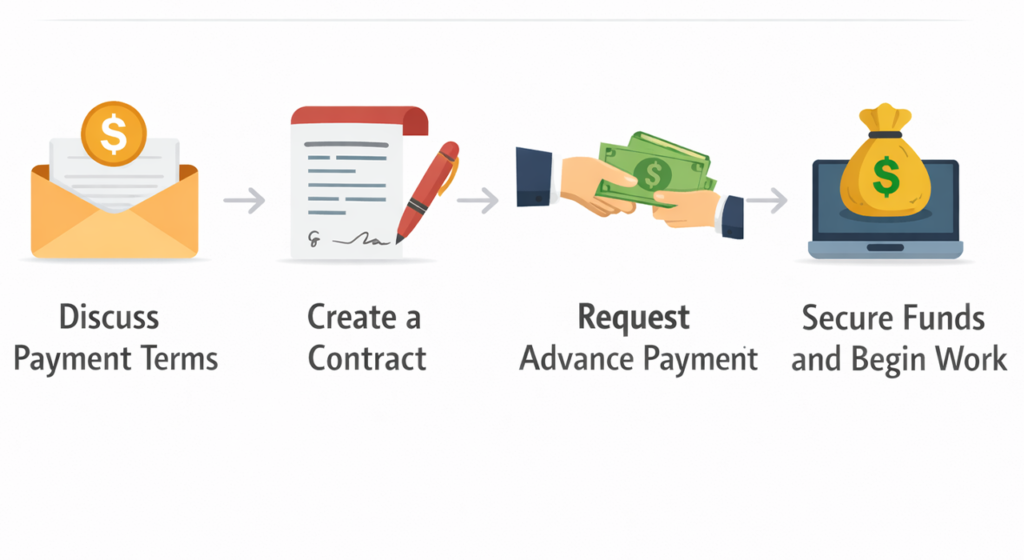
Now let’s discuss how to take advance payment from a client and what is the best method. The best approach for beginners is to demand a 50% advance payment and never start work without an advance. You should always take 50% upfront. This is a professional approach, and serious clients understand this. When a client gives an advance, they automatically become serious, and you also get the security that your time will not be wasted.
How to Ensure Full Payment After the Advance
But here another concern arises. Beginners fear what will happen if the client gives a 50% advance and does not provide the remaining 50%? This is also a real issue and should not be ignored. The solution to this is also simple, you just have to be a little smart.
You should structure your work in such a way that you do not deliver the final thing until the client makes the remaining payment. For example, if you are building a website, you can design and develop the entire website, but do not give final access, login details or live website until the client clears the remaining payment. This way the client will have the work, but will not be able to use it properly until they make the full payment.
Effective Delivery Strategies for Designers
Consider another example. If you’re a graphic designer, instead of delivering the final image file, you can take a screenshot from your mobile and send it to the client. Whether you’re working in Photoshop or Illustrator, simply show a preview and tell the client that the work is complete. Now, pay so I can deliver the final files. This is a very effective method. The client understands that if they delay, they won’t get the final work. This increases your respect and maintains control.
Smart Pricing Strategy for Financial Safety
Another smart strategy is to set your pricing so that the 50% advance you take covers your basic effort and time. If you take on a $100 project, plan so that the $50 advance covers your work. Consider the remaining $50 as a bonus. If you get it, it’s best, and if you don’t, you still won’t lose.
This approach is very powerful for beginners because it reduces their financial pressure and helps them work safely. When you work stress-free, you can negotiate confidently with clients. When you’re not desperate, you can make strong decisions.
The Importance of Mindset and Setting Boundaries
Here’s another important point to understand. Freelancing isn’t just a game of skills, it’s also a game of mindset. If you behave weakly in front of every client, the client won’t take you seriously. But if you maintain a professional and confident approach, the client will respect you.
You need to set your boundaries right from the start. Clearly tell the client how many revisions will be free and after that, extra charges will apply. Payment terms should also be clear, such as 50% advance and 50% before final delivery. When you make these things clear in advance, there are fewer problems in the future and the client also feels that you are professional.
How to Identify Serious Clients
A common issue with beginners is that they agree to everything out of fear of losing the client. They feel that if they ask for an advance, the client will leave. But the reality is that a client who is not ready to give an advance is often problematic. It is better to stay away from such clients, because they create more problems in the future. Serious clients always prefer freelancers who keep their terms clear.
When you understand your value and behave accordingly, you’ll find better clients. For long-term success in freelancing, it’s not enough just to work; you also need to optimize your processes. Payment systems, communication, delivery—everything must be organized. These things transform you from a beginner to a professional.
If you follow this strategy on every project—take a 50% advance, deliver the important parts at the end, and keep pricing smart—you’ll secure yourself and your confidence will also increase.
Conclusion: Be Your Own Boss
Ultimately, it is very important to understand that in freelancing you are your own boss. But when you don’t get clients and don’t earn, a person becomes ready to do anything for any client. Many people start freelancing with the thought that they will be the master of their own will, but when reality sets in, they believe anyone.
So, if you don’t keep your policies strong, anyone can exploit you. Every project is a learning experience. If you have made a mistake in the past, learn from it and take a better decision next time. Smart freelancers are those who don’t just work, but also strengthen their systems, improve their skills, and develop themselves.
When your system is strong, clients respect you, getting paid becomes easier, and your freelancing career becomes more stable.
That’s all for today’s article. If you liked it, please share your opinion in the comments section, and if you have any suggestions, please do so.

Ghulam Muhiudeen is a passionate blogger, SEO specialist, and online earning expert. He started his career with freelancing and provided content writing and website designing services on Fiverr from 2022 to 2024. During this time, he experienced firsthand the market’s intense competition, algorithm changes, and inconsistent income.